Archive for Lapis & Gold
The Artist Illuminated, a Poem
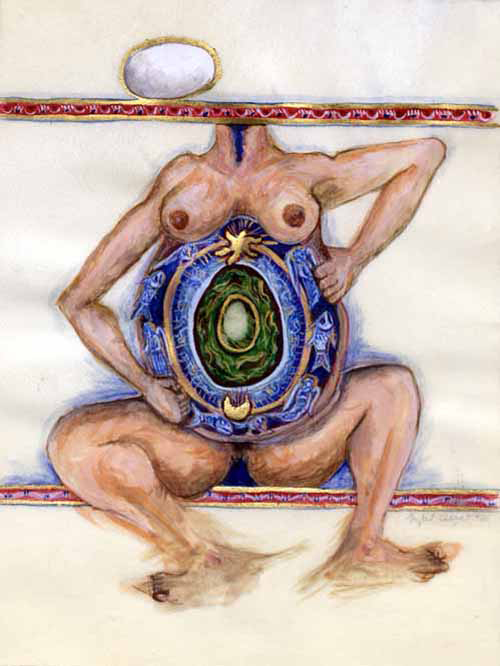
Fire on Top, An Illumination by Sybil Archibald
22k gold leaf and handmade paints on animal skin parchment
Over at Abbey of the Arts, Christine is holding a poetry party. She writes:
I invite you this week to write a poem about your own invitation to enter the refiner’s fire – in alchemy lead is transformed into gold through heat and this becomes a metaphor for the human soul. What is the lead within you ready to be transformed into something treasured?
I am not normally a poet but this topic is near and dear to my heart, so I was inspired.
Over the years, I’ve made a deep study of early alchemists and their influence on medieval art techniques. The process of manuscript illumination is deeply sacred and transformative. My early embrace of these techniques allowed me to see that making art, regardless of medium, is a spiritual practice. Though I use many different mediums now, within me the spiritual crack opened by illumination continues to expand with Light.
For more on the technique and meaning of illumination, see my posts Finding the Sacred in Contemporary Art and Lapis & Gold.
The Artist Illuminated
Parchment
I trace the lines of God
on this dead skin-
a calf once, a self
prepared to be reborn.Gilding
The red clay of Adam
laying lifeless upon skin,
desiring yet empty.Deep within
I find it-
Divine breath,
hot, filled with life.Exhaling,
I wake the glue which binds
body to soul,
giving form to life.The once rough clay
is now perfected
by a blanket of gold.With a flash the gilded clay rises up,
a wild horse running free,
as the newly golden surface
reflects living Light
back to Its
SourceMaking Paint
I crush azure blue from a stone like so many grapes
All the while
emptying
my frail body of care,
surrendering concern.Bleeding madder root in a bubbling pot,
heating iron over a fire to red.
Finding within
this lifeless squid,
its precious gift:
warm and brown
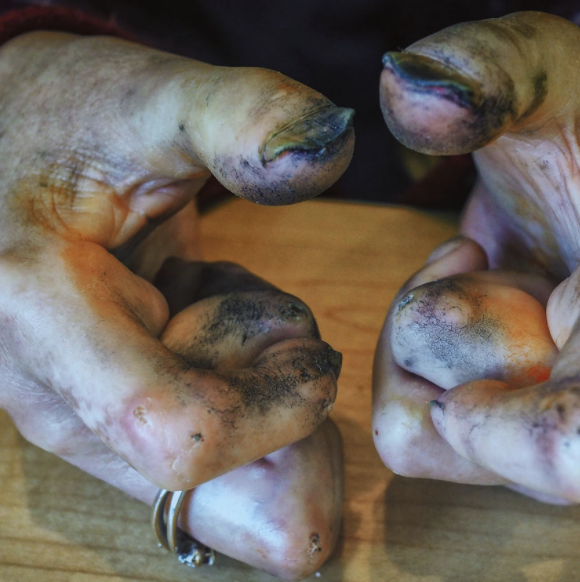
sepia stains my palms.The Artist
Thus paint is made,
and my own skin emptied,
a self once,
prepared to be reborn.Here in this moment I stand
an emptied vessel.I dip my brush
and disappear.I am the the glove
for the fiery blue Hand of the Artist
which destroys as it creates.I have been consumed
In tender, burning flame
a shell of my former self
all ashes, all dustwhich I collect and slowly
begin to grind into paint.-Sybil Archibald
Lapis & Gold
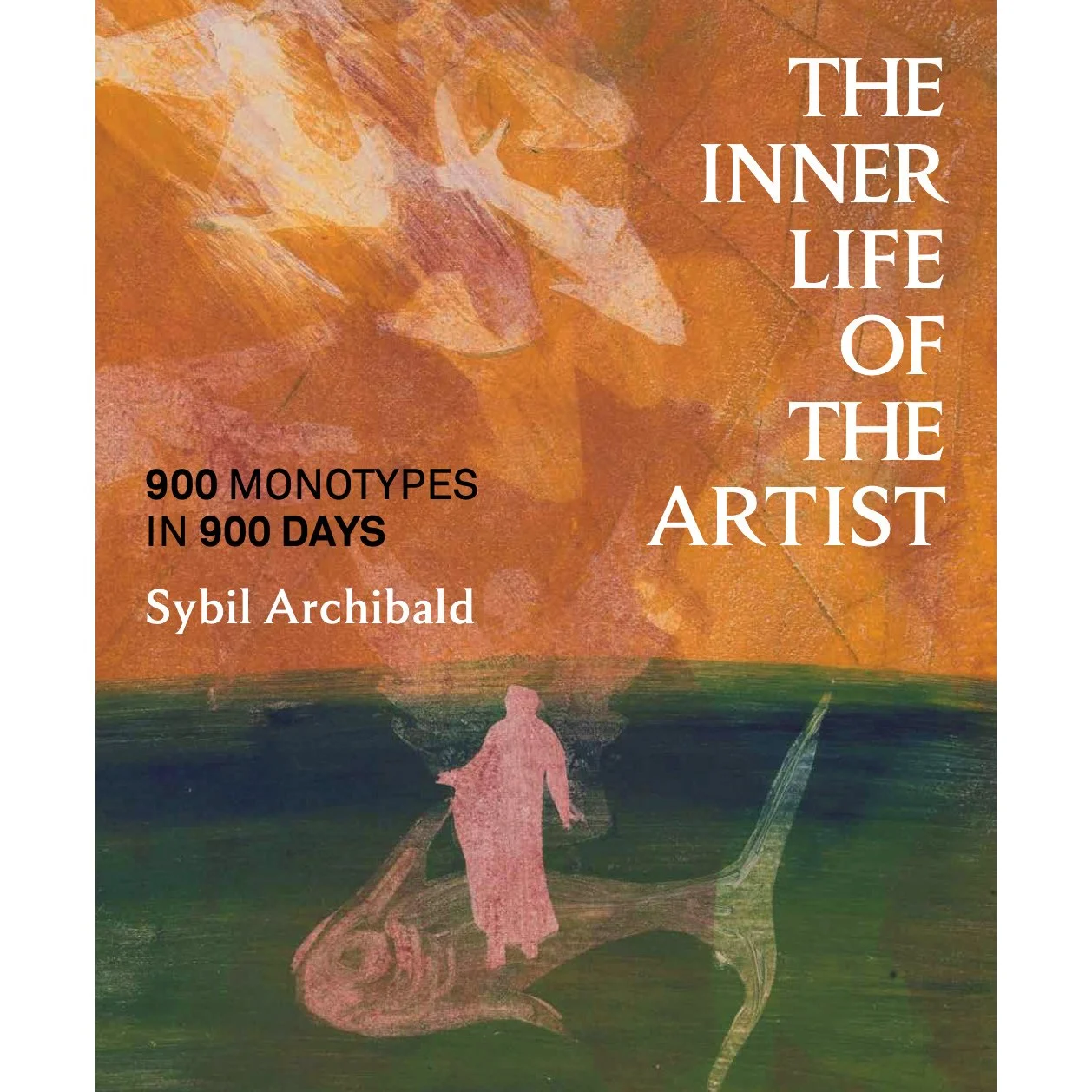
I just updated the website for my book Lapis & Gold: Unlocking the Secrets of Medieval Painters and Illuminators. It’s an in depth look into medieval art technique and sacred and spiritual art practices. I hope it will help contemporary artists reclaim the power we’ve lost by relying on industrialized art supplies that pollute our environment and lack longevity. I also hope it will add to the dialogue about art as a spiritual practice. My writing partner, Karen Gorst, is a technical genius. There is so much in this book that has never been put to paper before. I’m really excited about it.
I first became interested in illumination during college when I studied at the School of the Sacred Arts at the same time as I was immersed in studying medieval mystics at NYU. It seemed like the perfect art form to me, a marriage of the mystical and material. It is through illumination that I first began to understand the sacred and healing nature of making art. For many years, I strictly adhered to illumination technique:

The Binding of Isaac (Click image for larger view)
Now I just incorporate the techniques. I still make my own art supplies where I can but not always and I often work on paper instead of parchment. My work, however, is still true to the core values of the illumination technique: trust in process, trust in materials, and connection to the Divine. As Above, so below; the artist imitates the Divine Artist.
I haven’t written much about my book here because I’ve been on an unplanned, life-enforced break. It had to be set it aside to help my husband close down his business in 2006 and then I had my heart episode/awakening and then our big move which caused my life to unravel into the chaos from which new things are built. I have, however, talked about many of the same themes of spirituality and have touched on technique in a few posts (see Finding the Sacred in Contemporary Art).
I hope Lapis & Gold will appeal to a wide range of people. It has information for artists, art historians, spiritual seekers, conservators, medievalists and students of religion. Each chapter has technical information, ancient recipes tested and refined for contemporary use, history, and spirituality. (Click the links for chapter table of contents).
Supports: Paper and Parchment
Ink
Calligraphy
Gilding
Pigments and Pigment Making
The Pigment Almanac (A reference guide to pigments)
Paintmaking
Projects
A list of appendices
Here a sample of the types of information you will find in different chapters: the pigment chapter has detailed recipes, lightfastness & pigment interaction testing, and an in depth look at the alchemists who developed these recipes, their spiritual belief systems and how those believes manifest as you actually make each recipe; the calligraphy chapter has, among other things, directions for 3 writing styles, calligraphy as meditation, letter mysticism is the Christian, Judaic & Islamic traditions and the analysis of a medieval page to understand layout.
So now finally the time is right to begin again on the journey that is my book. The writing in finished. Lapis & Gold has ripened* on the vine & is waiting for a hungry publisher to come and pluck it. Any advice, contacts, or help you could offer would be greatly appreciated!
Thank you and bless you! Sybil
* Upon rereading this, I was amused to find that I had unconsciously used the same metaphor as medieval alchemists who sometimes referred to the metals in their chemical reactions as ripening.
Buying Paper: A Blast from the Past
Yesterday I went to NY Central Art Supply to buy paper. It was a weird, weird experience for me. I used to practically live there in the paper section. They have the most amazing paper selection- like you died and went to heaven! But around 15 years ago, I gave up paper and store-bought art supplies. I worked almost entirely on animal skin parchment and made my own paints & inks from scratch. I even made a lot of the pigments from vegetable and mineral sources. See my book Lapis & Gold for more on this.
Using these techniques meant that I didn’t set foot in NY Central for 15 years.
Going there again was almost like going back to a childhood home and seeing someone else’s furniture. One of the sales people called me ma’am. I had my 7 year old in tow. I thought people were looking at me like I was an alien. And yet it was sweet to be there again. God I love paper! I love artists.
In all probability people weren’t looking at me like I was an alien. I just felt that way because nothing had really changed there except me. Even some of the sales people were the same. I felt I should be walking around the corner to have a beer at the Village Idiot (long since closed) with my friends and not return home till 3am. I suddenly felt I had no responsibilities at all and then my son grabbed my hand. I don’t have the body I had, I don’t have the mind I had, or the pain & suffering I had. It was beautiful and sad at the same time. A paradox- the truest indicator of Divine presence.
Finding the Sacred in Contemporary Art
Today I was thinking about how to define what makes a art work spiritual. As I’ve said before, spirituality in art has nothing to do with the content of a piece. You could pack 100 angels and 20 crucifixions into a painting and that wouldn’t necessary mean it’s spiritual or sacred. Spirituality is not about thinking. (One might ask why blog then… but that’s a topic for another post!) You can think rationally about what your idea of spirituality is and perhaps you will paint an angel. But that angel will never be spiritual if you have not touched God in your creative process. I don’t mean artists have to have be full-time mystics, but I they do have to enter into Divine mystery and be transformed.
I’d like to use illumination to explain what the sacred in art means to me. When most people think of illumination, they think of medieval manuscripts which have traditionally spiritual images. But it’s not the images that make them holy, it’s the process. I will describe two examples:

1) Gilding: Gilding is the process of adhering a thin sheet of gold leaf to a panel, parchment or other painting surface. First the artist applies gesso which a paste made basically of clay and glue. Because the gold leaf is so thin, applying it to this wet surface would cause the gesso to seep up through the microscopic holes in the gold, dulling its shine. So the gesso is allowed to dry and then its glue reactivated by breathing deeply upon it. This gesso is likened the clay from which the Divine formed Adam the first man. When the artist breathes, it symbolizes the Divine blowing the breath of life into Adam.
Gilding is not easy. It requires the proper deep diaphragmatic breath or it will not work. To create this breath, the artist must achieve a calm focused meditative state. The symbolism of Divine creation, becomes more that a symbol. It is a road map telling the artist to tap the Divine well of creativity from which everything comes. The artist must release the self, to tap the Self. This is the transformation I speak about when I say something is spiritual art.

2) My next example is my experience working on my Binding of Isaac piece (pictured to the right). Again, another traditionally spiritual image made spiritual through process not content. It has an Islamic-style illuminated border. These borders are steeped in sacred geometry, in God as Divine Intellect. While I was painting this piece, and the same with other pieces I’ve done using those borders as inspiration, I felt my mind elevated. It is somewhat difficult to explain this. It was almost as it my mind was being pulled up, expanded. I felt larger was I completed this piece. There was more space inside me to accept the world into. This piece transformed me, increase my ability to love. It is the artist’s transformation that is the key to spiritual work.
This type of spirituality is built into the long tradition of manuscript illumination, icon painting and other sacred arts. But all art has the potential to be sacred if, as artists, we approach our process as part of our own spiritual journey.
Update: For more on art technique & spirituality check my book Lapis & Gold: Unlocking the secrets of Medieval Painters & Illuminators.


In the figure of Jesus, God as revealed many things, not the least that Divinity and physicality can be merged. Whether you believe in Jesus or not, the symbol is a potent one. I am not suggesting that an artist can bring full Divinity into their work, but I am suggesting that Jesus is the macrocosm and art is the paler, yet important, microcosm, the echo for integrating the physical & spiritual.
In our society we have forgotten that everything we use is a fruit of the Earth. Perhaps it is easy to grasp that eggs come from chickens, but what of paint in tubes, plastic boots, or children’s toys? Let’s stay with the artist. How many artists know the source of their own paint? Does anyone realize that watercolor paint sticks to the page because of tree sap or that true ultramarine blue come from crushed stones? (More on this